You’ve spotted those big black ants marching across your kitchen counter. No big deal, right? Well, if they’re carpenter ants, you might want to pay attention. These insects are more than just a nuisance. They’re actually one of the most destructive pests that can invade your home.
Let us walk you through exactly what carpenter ants can do to your property and why catching them early matters so much.
The Shocking Reality of Carpenter Ant Damage
Here’s the straight truth: carpenter ants can cause thousands of dollars in structural damage if left unchecked. While they’re not as fast as termites, they’re still serious business.
A mature carpenter ant colony can hollow out significant portions of wood in just 3 to 6 years. In some cases, severe infestations have caused damage exceeding $10,000 to $20,000 in repair costs.
The real problem? Most homeowners don’t realize they have carpenter ants until the damage is already extensive.
How Carpenter Ants Actually Damage Your Home
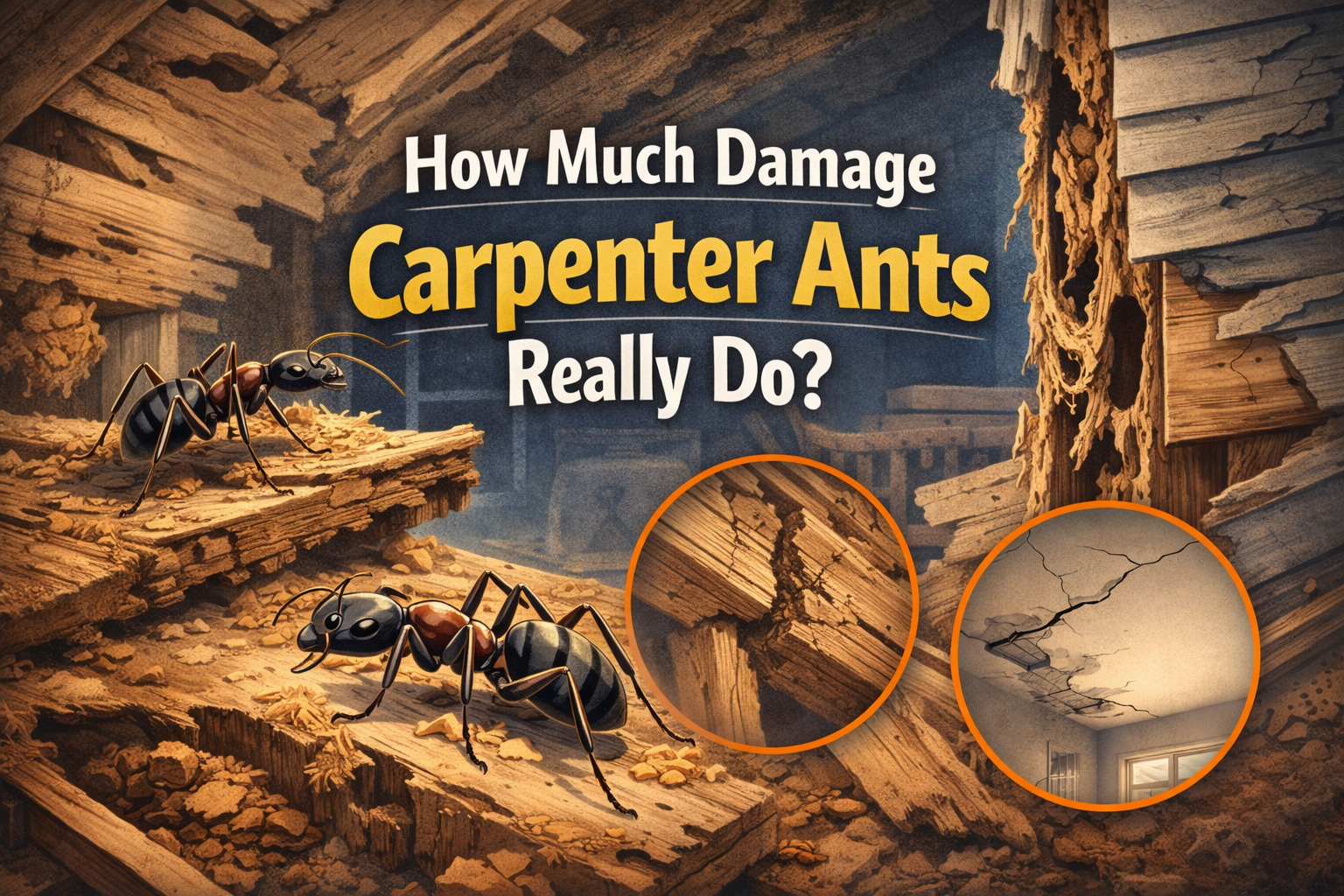
Let’s clear up a common misconception: carpenter ants don’t eat wood like termites do. Instead, they excavate it to create their nests.
Think of them as tiny construction workers tunneling through your home’s structure. They chew through wood fiber by fiber, creating smooth galleries and tunnels where their colony lives and expands.
What they’re doing:
- Carving out elaborate tunnel systems called galleries
- Creating multiple satellite nests throughout your property
- Weakening structural wood from the inside out
- Leaving behind frass (sawdust-like debris) as evidence
- Expanding their network as the colony grows
Where Carpenter Ants Strike First
These pests are smart. They target wood that’s already compromised, making it easier to excavate. Here’s where they typically set up shop:
Prime targets in your home:
- Water-damaged wood near leaky pipes or roofs
- Damp areas in basements and crawl spaces
- Wood in contact with soil around foundations
- Window and door frames with moisture issues
- Deck posts and porch columns
- Roof eaves and soffit areas
- Hollow doors and wall voids
The Timeline: How Fast Does Damage Happen?
Understanding the timeline helps you grasp the urgency:
| Time Period | What’s Happening | Potential Damage |
| Year 1 | Colony establishes, small galleries form | Minimal, often undetected |
| Years 2-3 | Colony expands, multiple nests develop | Moderate, localized weakening |
| Years 4-6 | Mature colony, extensive tunneling | Significant structural concerns |
| Years 7+ | Multiple large colonies possible | Severe damage, expensive repairs |
The scary part? A single carpenter ant queen can live for 10 to 15 years, continuously producing workers that expand the damage.
Real Damage Examples We’ve Seen
In our years working with homeowners, we’ve witnessed carpenter ant damage that would shock you:
Case 1: The Support Beam. An Ohio homeowner discovered their main support beam was 60% hollowed out. Repair cost: $8,500.
Case 2: The Deck Disaster An entire backyard deck needed replacement after carpenter ants tunneled through moisture-damaged posts for five years. Total damage: $12,000.
Case 3: The Window Frame Nightmare Water damage around bathroom windows created perfect conditions. The ants destroyed framing that required extensive reconstruction: $6,200.
Carpenter Ants vs. Termites: Which Is Worse?
People always ask us this. Here’s the honest comparison:
Speed of damage: Termites win (or lose, depending on perspective). They eat wood faster.
Total potential damage: Both can cause catastrophic problems, but termites work more quickly.
Detection difficulty: Carpenter ants are actually easier to spot because they’re active outside their nests.
Treatment complexity: Both require professional intervention, but carpenter ants are generally easier to eliminate.
Cost of repairs: Similar in severe cases, both can require tens of thousands in structural repairs.
The bottom line? Don’t downplay carpenter ants just because termites get more attention. Both deserve immediate action.
Warning Signs You Can’t Ignore
Catching carpenter ants early saves you serious money. Watch for these red flags:
Visual evidence:
- Large black or reddish-black ants (0.5 to 1 inch long)
- Winged ants (swarmers) appearing in spring
- Piles of sawdust-like material below wood surfaces
- Faint rustling sounds in walls at night
- Shed wings near windowsills or doors
Structural clues:
- Wood that sounds hollow when tapped
- Small holes in wood surfaces
- Wood that feels soft or crumbles easily
- Visible tunnels in exposed wood
- Sagging floors or ceilings
The Hidden Costs Beyond Repairs
Carpenter ant damage isn’t just about fixing wood. Consider these additional expenses:
Property value impact: Homes with documented pest damage can lose 5% to 20% of their value
Insurance complications: Most homeowner policies don’t cover pest damage
Safety hazards: Weakened structures pose risks to your family
Mold growth: Moisture that attracts carpenter ants often leads to mold
Time and stress: Living with an infestation and coordinating repairs
How to Prevent Carpenter Ant Damage
Prevention is always cheaper than repairs. Here’s what actually works:
Moisture control (critical!):
- Fix leaky pipes, roofs, and gutters immediately
- Ensure proper drainage around your foundation
- Use dehumidifiers in damp basements
- Ventilate attics and crawl spaces adequately
Physical barriers:
- Seal cracks and crevices in your home’s exterior
- Trim tree branches away from your house
- Store firewood at least 20 feet from your home
- Replace water-damaged wood promptly
Regular maintenance:
- Annual professional inspections
- Monitor moisture-prone areas monthly
- Address wood-to-ground contact issues
- Keep your property clean and clutter-free
Why DIY Rarely Works
We get it. Those hardware store ant sprays look tempting. But here’s why they usually fail with carpenter ants:
- You’re only killing the ants you see, not the colony
- The main nest might be outside, in a tree or buried wood
- Multiple satellite nests require comprehensive treatment
- Improper treatment can cause colonies to split (making it worse!)
- You might miss moisture issues that keep attracting ants
Professional treatment addresses the root cause and eliminates entire colonies.
Treatment Costs vs. Damage Costs
Let’s talk numbers that matter:
| Service | Average Cost |
| Professional inspection | $100 to $200 |
| Carpenter ant treatment | $250 to $800 |
| Annual prevention plan | $300 to $600 |
| Structural damage repairs | $2,000 to $20,000+ |
See the math? Spending a few hundred on prevention and treatment beats spending thousands on repairs every single time.
Also Read: How Much Does Ant Pest Control Cost in Dayton?
Frequently Asked Questions
Can carpenter ants destroy a house like termites?
Yes, though it typically takes longer. Severe carpenter ant infestations can compromise structural integrity just like termites, especially if multiple colonies are present for several years.
How long does it take carpenter ants to cause serious damage?
Generally 3 to 6 years for a single colony to cause significant damage. However, the timeline varies based on colony size, wood condition, and moisture levels.
Will carpenter ants go away on their own?
No. Carpenter ant colonies grow larger over time and won’t leave voluntarily. They need professional treatment to eliminate.
How can I tell if I have carpenter ants or regular ants?
Carpenter ants are much larger (0.5 to 1 inch), have a single node between their thorax and abdomen, and leave behind sawdust-like frass. Regular pavement or odorous house ants are much smaller.
Do carpenter ants bite humans?
They can bite if threatened, but it’s rare. The bite can pinch, but it isn’t dangerous. They don’t sting like fire ants.
Is one carpenter ant a sign of infestation?
Not necessarily. Solo worker ants may wander in from outside. However, regularly seeing them indoors, especially in spring or finding them in the same area, suggests a nearby nest.
What time of year are carpenter ants most active?
Spring and early summer, when swarmers emerge to mate and establish new colonies. However, indoor colonies can remain active year-round.
Don’t Wait Until It’s Too Late
Carpenter ant damage doesn’t happen overnight, but every day you wait gives them more time to compromise your home’s structure. What starts as a few ants can turn into a costly nightmare.
The good news? Early detection and professional treatment can stop them in their tracks.
Get Professional Protection Now
At Pest Control Dayton, we’ve helped hundreds of Dayton-area homeowners eliminate carpenter ant colonies before they cause expensive damage. Our certified technicians know exactly where to look, how to treat effectively, and how to keep them from coming back.
Don’t gamble with your home’s structural integrity. We offer comprehensive carpenter ant inspections that identify colonies, assess potential damage, and create a customized treatment plan for your property.
Call us today for a free inspection or schedule your appointment. We offer same-day service and guarantee our work. Protect your investment before carpenter ants turn a small problem into a major expense.
Your home is likely your biggest investment. Let’s keep it safe together.