
You’re relaxing at home when suddenly you notice winged insects swarming near a window. Your heart sinks as you wonder: are these termites? Before you panic, take a deep breath. While both termites and flying ants swarm during similar times of year, they’re very different insects requiring different treatments.
As Dayton’s trusted pest control experts for over 15 years, we’ve fielded countless calls from worried homeowners asking this exact question. Let’s clear up the confusion once and for all.
Why This Matters
Correctly identifying these insects isn’t just about satisfying your curiosity, it’s about protecting your home and your wallet. Termites cause over five billion dollars in property damage annually across the United States, and they’re active right here in Dayton. Meanwhile, most ant species, while annoying, don’t pose the same structural threat.
Misidentifying these pests can lead to unnecessary stress or, worse, delayed treatment that allows real termite damage to accumulate. Let’s make sure you know exactly what you’re dealing with.
The Swarming Season
Both termites and flying ants have winged reproductive members called “swarmers” or “alates.” These winged individuals leave their colonies to mate and establish new colonies, typically in spring when temperatures warm up.
In Dayton, you’ll most likely see termite swarms from March through June, with peak activity in April and May. Flying ant swarms can occur from spring through early fall, depending on the species. The timing alone won’t tell you which insect you have, but it’s a helpful clue.
Body Structure: The Most Reliable Difference
If you can get a close look at the insect (and we recommend catching one for inspection), the body structure provides the clearest answer.
Termites have a broad waist with no pinched section between the thorax and abdomen. Their body appears straight-sided and uniform, almost like a small grain of rice with wings. This gives them a thick, rectangular appearance from above.
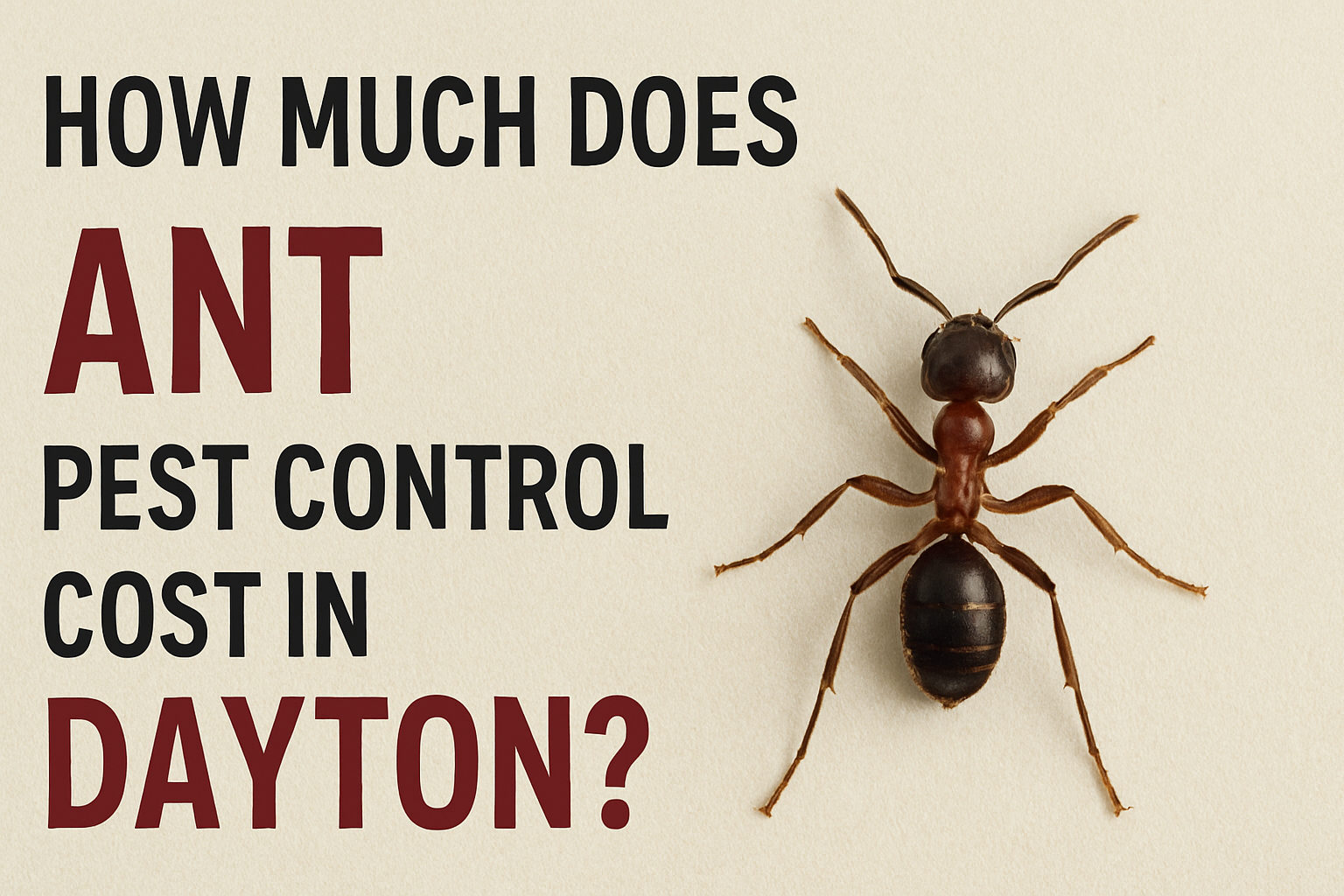
Flying ants have the classic “ant waist”, a very narrow, pinched section between the thorax and abdomen. This creates three distinct body segments that are clearly separated. Think of it as an hourglass figure.
If you’re having trouble seeing this detail, try capturing one carefully in a clear jar or taking a photo with your phone’s macro mode.
Wing Differences: A Telltale Sign
The wings provide another excellent identification feature, though you’ll need to look closely.
Termite wings are uniform in length—both pairs are the same size, extending well beyond the insect’s body. They appear almost translucent or milky white, with a simple pattern of veins. When termites shed their wings (which they do after swarming), you’ll find neat piles of identical-sized wings, often near windowsills or doors.
Flying ant wings have two pairs of different sizes, the front wings are noticeably larger than the back wings. The wings are more proportionate to the body and have more visible veining. When shed, ant wings will be scattered more randomly and show obvious size differences.
Antennae: Straight Versus Bent
Look at the antennae if you can see them clearly.
Termites have straight, bead-like antennae that resemble tiny strings of pearls. There’s no bend or angle in them.
Flying ants have elbowed or bent antennae, creating a distinct angle. This is consistent across all ant species.
Color Clues
While color alone isn’t definitive, it provides supporting evidence.
Termites found in Dayton are typically pale cream to dark brown or black, depending on their species and caste. Subterranean termite swarmers are usually dark brown to black.
Flying ants can range from red to brown to black, depending on the species. Carpenter ants, often confused with termites, are typically all black or red and black.
Behavior Patterns
Watching how these insects behave can offer additional clues.
Termites are attracted to light sources and often swarm near windows and doors. They’re weak fliers and tend to flutter rather than fly in straight lines. After landing, they quickly shed their wings and seek shelter. You rarely see termites wandering around exposed areas—they prefer staying hidden in wood or soil.
Flying ants are stronger, more direct fliers. You’re more likely to see regular (non-flying) ants trailing to and from food sources. If you see ants crawling around your kitchen or bathroom regularly, the winged ones you spot are almost certainly flying ants from the same colony.
Where You Find Them
Location provides important context.
Termites need moisture and wood. In Dayton homes, you’re most likely to find evidence of termites near the foundation, in basements or crawl spaces, near leaky pipes, or in areas with wood-to-ground contact. Mud tubes climbing foundation walls are a dead giveaway of subterranean termites.
Flying ants might emerge from colonies in walls, under sidewalks, in lawns, or in rotting wood. Carpenter ants specifically nest in wood but don’t eat it, they excavate galleries that leave behind sawdust-like frass.
The Quick Reference Chart
Can’t remember all these details? Here’s a quick summary:
Termites:
- Straight, thick waist
- Equal-length wings
- Straight antennae
- Weak, fluttering flight
- Pale to dark brown/black
- Near wood and moisture
Flying Ants:
- Pinched waist
- Different-sized wing pairs
- Bent antennae
- Strong, direct flight
- Red, brown, or black
- Various locations
What to Do Next
If you’ve identified termites, don’t panic, but do act quickly. Termites work slowly, so a few days won’t make a dramatic difference, but prolonged delays can lead to costly damage.
If they’re flying ants, you’ll still want to address the problem, especially if they’re carpenter ants, but the urgency is lower. Regular ants are more of a nuisance than a structural threat.
Professional Inspection: Your Best Option
Even with all this information, identifying swarmers can be tricky for the untrained eye. As a local Dayton pest control company serving the community for 15 years, we offer thorough inspections that give you definitive answers.
We use safe, non-toxic methods to eliminate whatever pest you’re facing, and we understand the specific challenges Dayton homeowners encounter. Whether you’re dealing with termites that need immediate treatment or ants that require a different approach, we’ve got you covered.
Still not sure what you’re seeing? Contact us at hello@pestcontroldayton.org or give us a call. We’re happy to help you identify your pest and recommend the right solution. Don’t let uncertainty put your home at risk—reach out today for peace of mind.